Door-to-Door Delivery Service in India (Fast, Reliable & Cost-Effective)
April 15, 2026
AAJ Swift
Share
Businesses that move goods across cities or states often deal with delays, extra costs, and damaged shipments because the delivery process involves multiple stages. A typical shipment passes through pickup vendors, transport hubs, and local delivery teams before reaching the consignee's address. Each additional handling point increases the risk of delay and damage. Industry practices show that more handling and multiple handovers directly impact delivery timelines, especially in B2B freight, where shipment size and value are high.
AAJ Swift's door-to-door delivery service solves this operational gap by managing the entire shipment under a single point of responsibility. A singlelogistics partner handles pickup from the origin and ensures delivery at the exact destination address without shifting accountability between multiple partners. This approach reduces handling points, improves delivery predictability, and gives businesses better control over their shipments. Businesses that ship part truckload freight, bulk goods, or regular orders rely on door to door delivery. It helps them maintain consistent service quality, reduce coordination effort, and avoid hidden costs.
What Is a Door-to-Door Delivery Service?
SendingB2B freight from Delhi to Pune shouldn’t be a headache. You book a truck. You load your goods. The truck drives 1,400 kilometers straight to your buyer’s exact address in Maharashtra. This is the simplest example of a door-to-door delivery service.
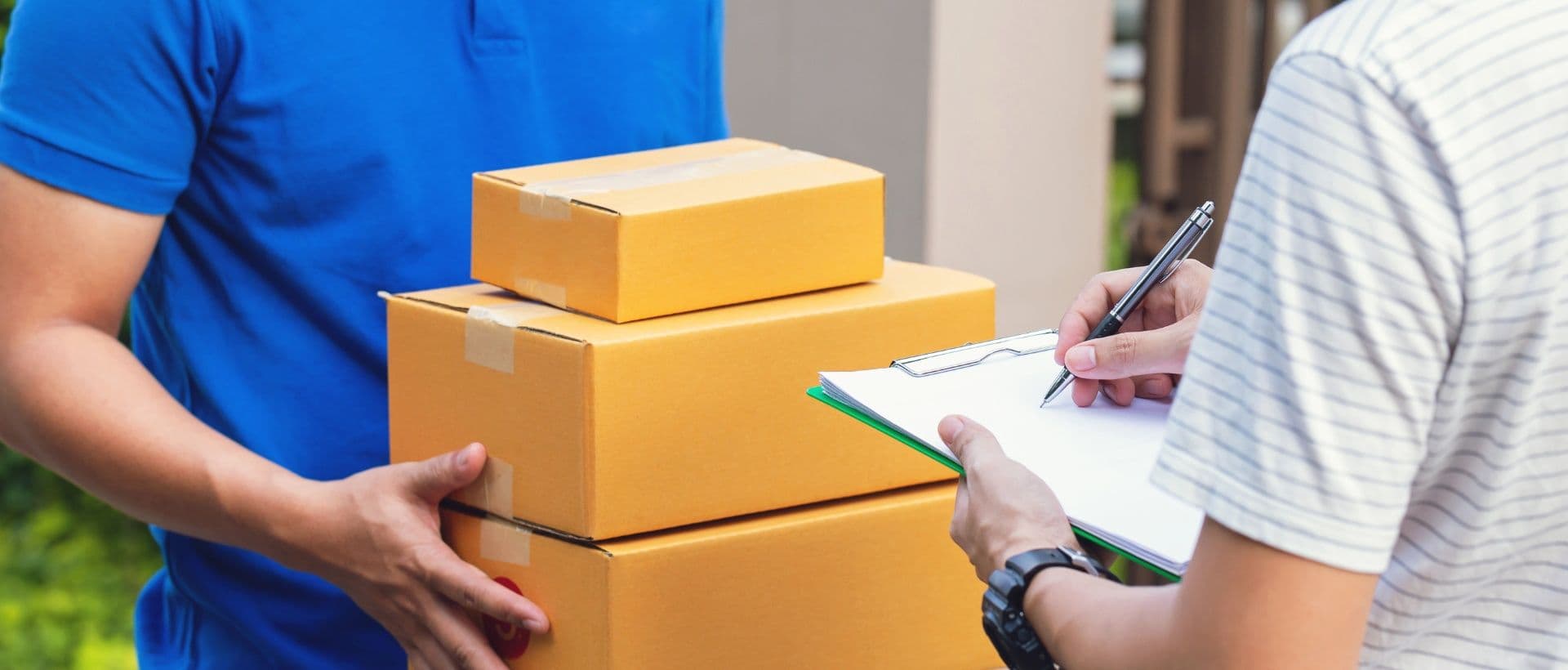
So, door to door delivery simply means a transport service picks up the material right from your factory gate or warehouse and delivers it exactly at your clients’ doorsteps. No middlemen are involved here.
Now, let’s have a look at how this delivery model can be compared with other delivery services:
Feature
Door-to-Door Delivery
Hub-to-Hub Delivery
Self-Drop Courier
First-Mile Pickup
Truck arrives at your warehouse.
You have to hire a local tempo, load it, and send it to their main hub.
You physically carry your box to a local courier shop.
Last-Mile Drop
Goods are unloaded exactly at the destination.
The main truck dumps the goods at a destination hub.
Doorstep delivery possible
Hidden Costs
Zero. You get one single invoice for the entire journey.
High. You pay for the transport from/to warehouses to shops, and laborers to load/unload at both ends.
Usually less than hub-to-hub system
Handling & Damage Risk
Very low. A single partner processes goods through a controlled network.
High. More handling equals more broken goods.
Medium. Tiny parcels get tossed into big bags and thrown around in transit.
Best Used
Heavy B2B freight, pallets, bulk textiles, and part-truck loads (PTL).
Businesses that want to cut every single rupee and don’t mind the massive headache.
Sending a legal contract, invoice or 1 kg product sample.
Time Wasted
None
High
Low
How Door-to-Door Delivery Works (Step-by-Step)
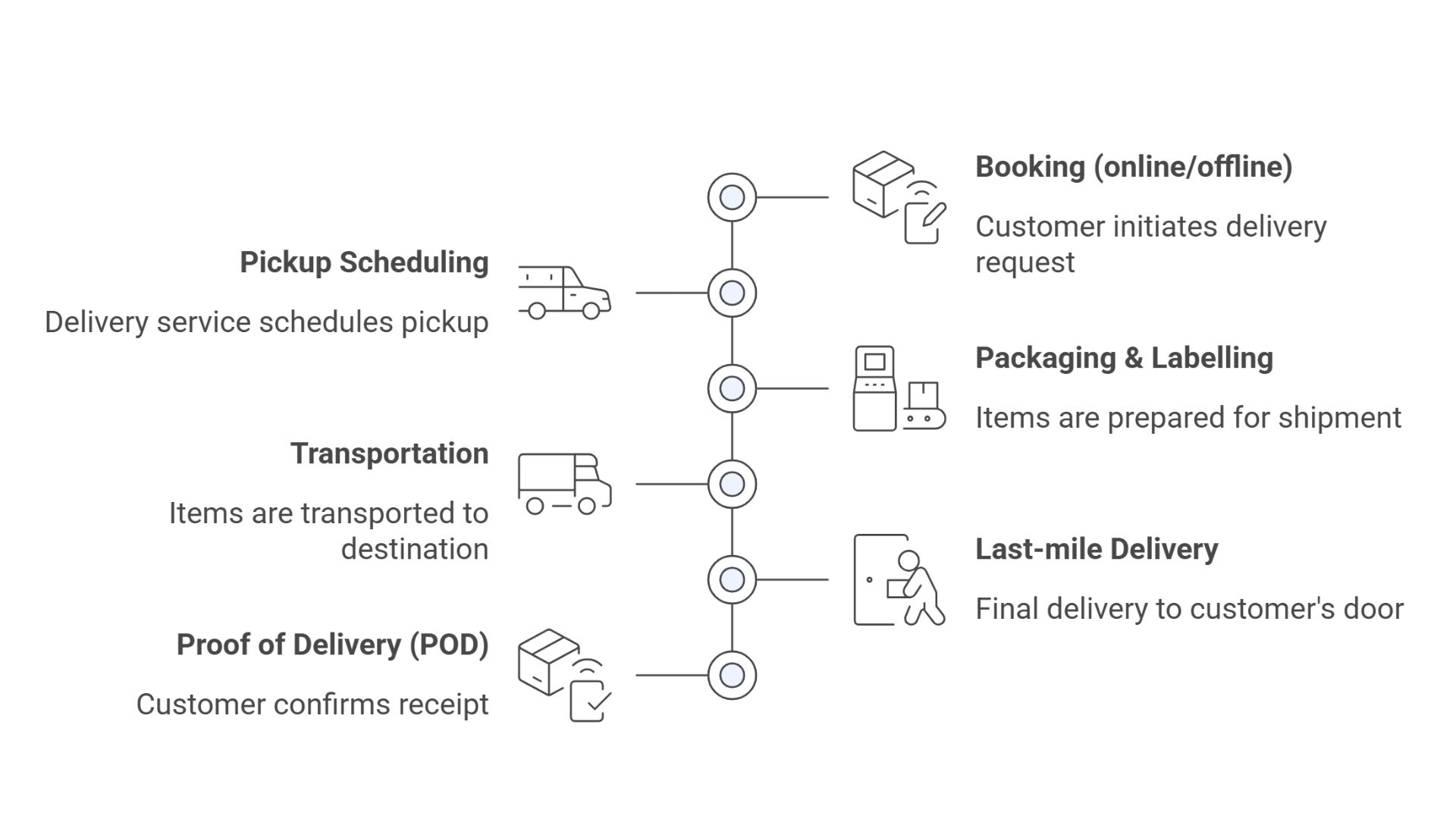
Here is a step-by-step guide on how door-to-door delivery works:
1. Booking (online/offline)
Everything starts with the booking. You log into your logistics partner’s portal, or if you prefer the old-school way, you call your account manager. You tell them what you are sending, the weight, the dimensions, and the pickup location.
2. Pickup Scheduling
A pickup vehicle is assigned and scheduled to your dispatch location. If you are shipping a few boxes, a small van arrives. If you are shipping ten pallets, a larger truck shows up.
3. Packaging & Labelling
In B2B, the seller usually processes goods for final shipping, but inB2B logistics, things are more optimized based on minimizing the weight and dimensions. Logistics partner also makes sure every single box has a clear, scannable barcode label with accurate tracking.
4. Transportation
Your goods are then loaded onto the same truck that is destined for a city or state.
5. Last-mile Delivery
When a truck reaches the destination city, it then unloads the goods to the locallogistics hub. The goods are then sorted based on pincodes and then loaded into smaller delivery vans. These vans navigate the local traffic to reach your buyer’s exact address.
6. Proof of Delivery (POD)
The delivery driver gets the receiver to sign a physical document or share a digital OTP. This POD is then uploaded to the system to initiate the final invoice.
Types of Door-to-Door Delivery Services
Not every business needs faster delivery services every day. They sometimes need to deliver goods faster and sometimes want to save money, and for that, there are thefollowing types of door-to-door delivery services:
Standard delivery: This is the default choice for most businesses. Your goods travel by road on standard trucks. This usually takes about 5 to 7 days. It is highly cost-effective and perfect for regularly planned shipments.
Express delivery: When your buyer needs the goods urgently. For example, the assembly line will stop if they don’t get your parts on time. These services are faster, with dedicated team-driver trucks or sometimes air freight, and cut the transit time to 2-3 days. This also makes it expensive.
Same-day delivery: They are common for delivery within the city. But you will rarely use this for a 1,400 kmDelhi to Pune delivery unless you choose airways.
Scheduled delivery: Scheduled delivery ensures your logistics partner holds the goods and only attempts delivery during that exact time window. No waiting outside the gate. No rejected shipments.
Hyperlocal delivery: Think Swiggy or Zepto, but for business. It is for moving things within a very tight 5 to 10-kilometer radius.
B2B bulk delivery: This is a special case that deals with moving massive loads, machinery, or raw materials. Here, specialized handling equipment is used for both loading and unloading. These are primarily contracted on a long-term basis.
Door-to-Door Delivery for Businesses
Business Need
D2D Delivery Role
Real Benefit
e-commerce (D2C)
Ships custom orders fast from your workshop straight to the buyer’s house.
Gives small online brands big-company shipping speeds.
SMEs & Factories
Acts as your fully outsourced, reliable transport department.
You focus on manufacturing, not buying or fixing trucks.
Wholesalers
Moves high-value bulk shipments in a single, unbroken chain.
Prevents tampering and theft by skipping local loading hubs.
PTL Freight
Let’s you share a truck with others when you don’t have a full load.
You only pay for the space you actually use.
Reverse Logistics
Goes back to the buyer to pick up defective or wrong items.
Makes B2B returns completely stress-free.
Key Features of Door-to-Door Delivery Services
Here are some of the key features that you must look for in a B2C logistics company:
Real-time tracking: Calling a driver 10x a day is an old way of doing business. Modern services give you a live GPS link. You can see exactly where your freight is on a map at any time of day or night.
Multiple shipping modes: A good partner gives you choices. If the roads are flooded during the monsoon, they can easily switch your urgent freight to the rail network or air cargo.
Doorstep pickup: It is the biggest operational advantage as your dispatch team can focus purely on packing and generating e-way bills.
Cash on Delivery: Many buyers want to see the goods arrive before they hand over the money. The logistics partner acts as your collection agent. They collect the cash or digital payment upon delivery and safely transfer it to your bank account.
Insurance coverage: Trucks can be involved in accidents. Warehouses can catch fire. It is rare, but it happens. Reputed services offer transit insurance to give you financial aid.
API integration for businesses: This is a lifesaver for modern businesses. You just need an API key from the logistics company to add it to your e-commerce or online business portals.
Benefits of Door-to-Door Delivery
These are some of the reasons why smart businesses are completely moving goods to modern door-to-door delivery:
Faster fulfilment: By removing the middlemen and manual work, your goods now move faster. It also ensured on-time delivery within the average transit times.
Better customer experience: Most modern delivery has its own business headaches, and they don’t want to put extra effort into delivering to their customers. Delivering right to their door makes you look highly professional. This simply means happy, repeat customers.
Reduced operational cost: Door-to-door might look like a premium service on paper. But it comes with numerous hidden costs, for example, a pickup van, laborers’ wages for loading/unloading, toll taxes, etc. But with logistics, you have to make a single payment.
Scalable logistics: Business goes up and down. You might ship 50 kilos in April and 5,000 kilos in October before Diwali. If you own your own trucks, you are stuck paying for them even when they are empty. A delivery partner scales with you and reduces your cost.
Challenges in Door-to-Door Delivery
The following are the challenges you might face in door-to-door delivery in India:
Delivery delays: You have long lines at commercial toll plazas. You have sudden interstate checks that can hold a truck up for hours.
High last-mile cost: Running trucks on open highways is cheap and fast. But navigating a small delivery van through the crowded, chaotic streets makes that final drop-off more challenging.
Damage risk: Every single handling of boxes increases the risk of getting damage. So, if you don’t pack the box correctly, it gets easily crushed during transport.
Address issues: Indian addresses can be a bit of a puzzle. Incorrect or wrong addresses also consume and waste a massive amount of time and fuel during last-mile delivery.
Pricing of Door-to-Door Delivery in India
What Determines the Cost
Effects on Invoice
Actual vs. Volumetric Weight
Logistics calculates both actual weight and volume. You end up paying whichever number is higher.
Delivery Speed
You pay a premium for express. If your buyer can wait 5 to 6 days, standard road freight saves money.
Fuel & Highway Surcharges
Diesel price spikes, highway toll taxes, and truck availability are the main reasons for changes in the final invoice amount.
How to Choose the Right Delivery Partner?
Your transport partner is literally the face of your company. If the truck driver is rude or the boxes arrive crushed, your buyer blames you. They don’t blame the transport company, but only blame you.
So, when you look for a door-to-door logistics partner, keep the following things in mind:
1. Look at Their Actual Setup
Check whether they actually own their warehouses and truck fleet. Or are they just a broker who takes your booking and passes your goods off to a random third party?
2. Check Their Technology
If a logistics company cannot offer you a simple online dashboard and real-time GPS tracking today, walk away.
3. Find True B2B Experts
Retail couriers don’t get commercial freight. Look for companies like AAJ SCM that actually understand the B2B space inside and out.
4. Check Their Operational Skills
You want a team that knows exactly how to handle your loads without mixing up boxes, and a partner that completely understands the strict new rules of e-way bills.
Door to door delivery has moved from a convenience-based option to a necessary part of modern logistics operations. Businesses no longer want to manage multiple vendors, coordinate different stages, or deal with delays caused by unnecessary handovers. A single, streamlined approach gives better control over shipment movement, reduces handling risks, and improves delivery consistency. Businesses that choose the right door to door service partner can maintain service quality, control costs, and ensure that every shipment reaches the delivery address without complications.