How Professional Transport Services Improve Business Operations in India
Read More
Loading...
April 16, 2026
AAJ Swift


Most ecommerce businesses don’t struggle with getting orders, they struggle with delivering them efficiently.
A customer places an order, everything looks fine on the surface, but behind the scenes, things start breaking down. Inventory may not be updated properly, dispatch may be delayed, the courier may miss the pickup, or the order may be returned after multiple delivery attempts. What looks like a simple process is actually a complex system where even small gaps can lead to higher shipping costs, poor customer experience, and lost revenue.
This entire procedure, from storing products to delivering them to customers, is what we call ecommerce logistics. But in reality, it’s not just about the movement of goods. It’s about how well your operations, technology, and delivery network work together.
You run an online store. Someone sitting in Pune or Guwahati likes a pair of shoes you are selling and hits the buy button. From that exact second, right up to the moment a delivery person hands over the parcel at their doorstep, everything that happens in the background is ecommerce logistics.
So, you can call it the physical movement of your digital sales. But this doesn’t end there. What if the customer doesn’t like the shoes? In that case, bringing it all the way back to yourself also counts under e-commerce logistics.
In other words, your website might be the face of your brand, but logistics is the actual backbone. Without it, you are just running a digital catalog.
It looks simple from the outside. A box moves from point A to point B. But inside, there is a complex operational sequence of events that makes it run smoothly. Here are all of the steps:
All the products on your e-commerce store must be physically placed somewhere. If you’re starting, then it might be a small spare room, or you already have your warehouse. For bigger brands, it is a massive warehouse.
However, e-commerce marketplaces like Amazon and Flipkart offer fulfilment centers to store goods for faster shipping. This service is also available if you choose a logistics company that has its own warehouse and fulfillment centres, such as AAJ Swift.
Once the customer places an order, you will receive a notification on your e-commerce website. The system then captures the user’s data, such as prepaid or COD, pincode, and the actual stock status of that product. The software then syncs with warehouse data and drops a task for the floor staff to get moving.
Warehouse staff get an alert on where to pick the item. And once they pick the item from the shelf, it goes directly to the packing station.
If you are shipping fragile glass items, you need to use heavy-duty bubble wrap. For stuff like clothing, a simple tamper-proof flyer works. Once packed securely, the shipping label is affixed to the package.
This can be different based on what you have or what type of shipping you do most.
In the industry, there are two main shipping methods: PTL and FTL.
If you’re shipping tons of goods or a big, fragile item, then a full truckload (you pay for a full truck) is best. However, in 95% cases, especially in e-commerce, Part Truck load (you pay for the space your goods took) is used.
In any case, your package gets scanned and transferred into the transit network. From here, it travels to the destination city.
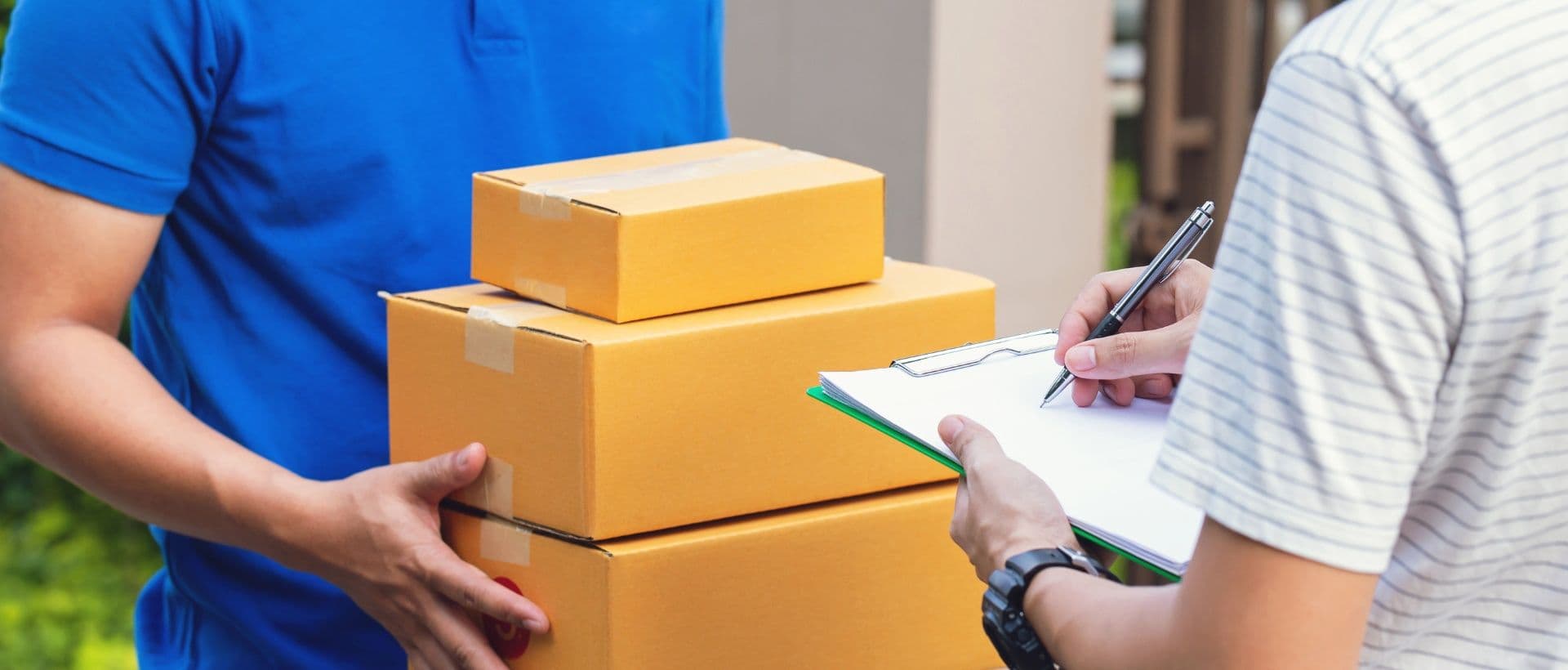
This is the hardest part. The parcel is in the customer’s city. Now, a local delivery executive puts it in his bag and drives out.
He deals with traffic, rain, missing house numbers, and customers who don’t pick up their phones. So, getting it from that local logistics center into the buyer's actual hands is what we call the last mile.
The customer opens the box, then decides the size is wrong. They click ‘Return’ on your website (here, the whole cycle runs backward).
The delivery executive then rides back to your customer’s doorstep to pick up the item (after quality check). The package then travels back to your warehouse and gets restocked.
Every business is different. A guy selling 10 pairs of shoes weekly does not need the same setup as a brand doing hundreds of shipments daily.
You manage everything. You’re the one who either stores goods at your home or rents a dedicated space. On top of it, you or your team do the packing and negotiate directly with the courier company about the transportation pricing.
This gives you an edge, as you control how the box looks and feels to the final customer. However, it is exhausting when sales spike during festive seasons like Diwali sales.
This stands for Third-Party Logistics. You basically outsource the headache. You send all your stock to their warehouse. Their software connects to your website.
When an order drops, their guys pack it and ship it. You just pay them for space and labor. It frees you up to actually focus on marketing and growing the business.
You don’t own any stock. You just build the website and run Facebook/Insta ads. When a customer buys a smartwatch from your site, the order is sent directly to a manufacturer in another city or country.
They pack it and ship it directly to your customer. You keep the profit margin, but you have zero control over shipping speed or packaging quality.
Think of these as highly advanced 3PLs. They are massive, tech-driven hubs located in prime zones and major cities. Brands use them to split their inventory across the country.
By keeping some stock in the North, some in the South, and some in the West, you ensure that the product is always physically close to the buyer. This reduces delivery times from 5 days to just 1 or 2 days.
The following are some of the challenges that you might face when shipping products to your e-commerce customers, along with solutions:
Return to Origin (RTO) is the biggest killer for any D2C ecommerce brands. To this day, a huge chunk of Indian shoppers still only buy on Cash on Delivery. And because their money isn’t stuck, their intent to actually take the parcel is very low.
So, if the customer refuses to take the order or returns it, you not only lose the forward shipping fee but also have to pay the return shipping fee. On top of it, that product is blocked for days.
Solution:
People are losing patience, especially when there are plenty of options available. So, when a parcel takes 7 days due to bad roads or rain, customers often don’t wait and cancel the order.
Solution:
A customer ordered a jacket for the first time from your online store. But when your team goes to the warehouse to pack it, the shelf is empty. This simply means that some of your team members miscounted it earlier.
Now, it’s you who needs to call the buyer and issue a full refund with an apology. This not only makes your brands look bad, but also increases the chance that they will never trust your brand again.
Solution: Ditch the manual Excel sheets. They always fail. You need a proper cloud-based inventory system. So, when a jacket is bought, the stock count in the warehouse software needs to drop to zero instantly—no human intervention.
Sending a huge truck between two cities is actually quite cheap per parcel. What costs serious money is paying a guy on a bike to drive three kilometers just to deliver one single box to one specific house. Fuel, salaries, and time add up fast.
Solution: This is where having a good ecommerce logistics partner helps. They group hundreds of orders for the same neighborhood together. If you are doing it alone, route optimization software is a must.
It tells your delivery guys the exact sequence of houses to visit so they aren’t driving back and forth across the same colony and wasting expensive petrol.
You cannot scale a brand manually today. It is impossible. You need to have tech in your workflow, as it is what separates struggling sellers from becoming massive brands.
Fixing and optimizing your logistics operations does take time and effort. But the payoff is absolutely massive.
Here is your quick checklist:
Tough questions to ask them:
Managing daily orders and fighting over margins with your B2C logistics partner can easily make any business owner exhausted. But the best part is that, with the logistics companies, you don’t need to figure it out yourself.
So, it is the right time to cut this headache and focus more on your business. And that is exactly where AAJ Swift comes in.
We provide pan-India reach, real-time tracking, and transparent pricing, while at the same time handling all your shipping headaches. So that you focus more on getting sales. Get your quote now, and make your logistics headache-free.