What is Route Optimization in Logistics? A Complete Guide
February 26, 2026
AAJ Swift
Share
Fuel prices are rising, delivery timelines are shrinking, and transport routes are becoming more complex every year. Basic route planning and driver experience are no longer enough to deliver efficiency. Today, a single vehicle may handle multiple stops across different cities, navigate traffic congestion, manage delivery time windows, and still be expected to reduce cost per kilometre.
In this environment, manual route planning starts to break down. The shortest route is not always the fastest. The fastest route is not always the most fuel-efficient. Small inefficiencies, extra kilometres, idle time in traffic, and poor load sequencing all silently increase operational costs and reduce margins.
Route optimization is a data-driven approach that calculates the most efficient delivery path. It considers distance, fuel usage, vehicle capacity, traffic conditions, delivery priority, and operational constraints. Instead of relying on assumptions, it uses structured inputs and algorithms to improve cost control, delivery performance, and fleet productivity.
As transport networks become more demanding, route optimization is no longer a luxury. It has become a core operational necessity for modern logistics.
What is Route Optimization?
If you give a driver 10 deliveries to make in Delhi, he makes a plan based on what he feels is right for them. Maybe he starts with the pin code closest to the warehouse, heading towards Noida, because he wants to drive back to his home in Ghaziabad. Or, maybe he avoids a certain road because of bad traffic.
But gut feeling is not always correct and sometimes more expensive. This is because it burns fuel.
So, route optimization isn't just about finding the way on Google Maps. It is the science of finding the most efficient route.
Think about the difference:
The shortest route: Might take you through a crowded bazaar like Chandni Chowk, where your tempo gets stuck for 2 hours. You saved 2 km but lost the whole day.
The fastest route: Might take a highway that has an additional toll plaza costing ₹500 extra.
Optimized Route: This is the sweet spot. It balances time, fuel, distance, and cost. It is also called the Smart Route.
How Route Optimization Works in Transport Operations
Route optimization isn't just about organizing the pickup or delivery points. It's more about an effective system. Today, B2C & B2B logistics service providers use software to provide optimized routes. Here is how it actually happens:
Order Data Input: You upload the orders with the dimensions of each box, such as 20 boxes for 8 different points.
Vehicle Capacity Mapping: The system then analyzes available trucks. Let's say Truck A (a 32-footer) and Truck B (Tata Ace). Based on the road conditions, pick one, as you can't send a big truck to the narrow roads of Chandi Chowk.
Delivery Window: Plan the route based on the availability of the recipient. If a mall only accepts goods between 7 and 9 am, you must plan a route to hit that window.
Traffic and Road Conditions: The system checks historical data. It knows that taking the NH-48 for a big truck at 9 AM is not the way to go.
Algorithm-based route: The system spits out a plan. It tells the driver: "Go to Party A first, then Party B." And thanks to GPS and Telematics, the office can see whether the driver is actually following the plan.
Real-time re-routing: It occurs when a road is suddenly blocked by a protest or a VIP movement.
Key Factors Considered in Route Optimization
These are some of the factors that you should consider when planning your deliveries:
Distance: Distance and fuel are dependent. The higher the distance, the more fuel is burned.
Traffic Jams: Traffic is a nightmare in India. Sometimes, even a 5 km distance can take 1 hr. So, real-time monitoring and smart routing should be done.
Vehicle Capacity: You can't send a half-empty truck on a long route. That's burning cash. And you can't overload a small truck too.
Delivery Priority: Sometimes, a VIP client needs their goods first (or a case of express delivery), even if it's not the most efficient stop.
Driver Working Hours: Drivers are humans. They need lunch and periodic rest. A good route plan these breaks so the driver doesn't burn out.
Toll Costs: Trading your 15 mins with a ₹200 toll price? Based on what you choose (speed vs delay), the system picks a route.
Return Load: The system plans a route so that the final delivery and pickup points for the return load are nearby. This helps burn less fuel and saves time.
Major Benefits of Route Optimization for Transport Companies
These are some benefits why all the companies are now adopting route optimization in their PTL transport services:
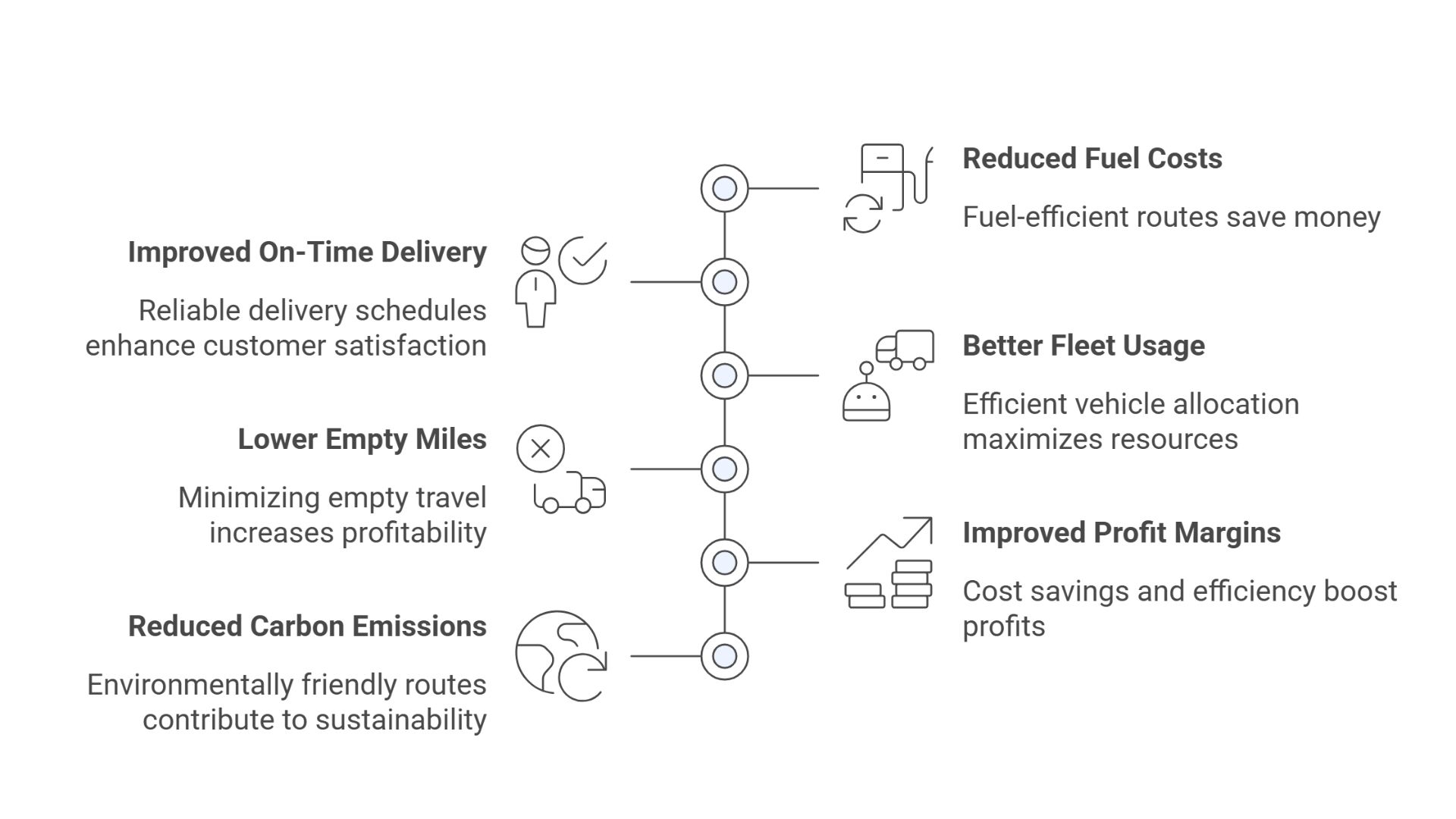
Reduced Fuel Costs: If you cut your daily kilometers by 10%, your fuel bill drops by 10%. For a fleet owner, that is pure profit.
Improved On-Time Delivery: Customers are always excited for their products. They want to know when exactly they get their orders. Optimization gives you accurate ETA timings.
Better Fleet Usage: Instead of using 10 trucks half-empty, an optimized route can show you how to deliver the same goods with 8 full trucks.
Lower Empty Miles: Driving an empty truck is simply burning fuel for no use. With an optimized route, these empty trucks can reduce their fuel consumption.
Improved Profit Margins: When costs go down and space utilization goes up, your margin increases.
Reduced Carbon Emissions: Less fuel burned means less smoke produced, which again helps in saving the planet.
Role of TMS in Route Optimization
You can't do route optimization in your head. You need a TMS (Transport Management System), which acts as the brain of your operations.
Centralized System View: It pulls orders from your order management system on your website or emails into one dashboard. No more going through Excel sheets.
Automated Route Generations: All available routes are one click away. Routes are ready in no time. So, a 2-hour job now takes less than 2 minutes.
Load Consolidation: The TMS sees that you have two small orders for the same industrial area and notifies you to combine them into one truck.
Performance Analytics: At the end of each week or month, you can ask for the TMS reports that help you decide which route is best for which type of deliveries, along with stocks that are selling fast.
Static vs Dynamic Route Optimization
People get confused here. Which one is better?
Static Optimization (The Bus Route Model): It has a fixed route.
Scenario: You deliver milk or bread. You have the same fixed distributors every day. The route never changes.
Best: Good for stable and predictable shipments.
Dynamic Optimization ( Uber/Zomato Model). This changes daily.
Scenario: Need to deliver 20 e-commerce orders in 10 locations of South Delhi today, and 20 deliveries in Noida tomorrow.
Best: Adapt as per real-time demand.
What works where?
PTL/ Line Haul: Usually Static. The truck goes Noida -> Jaipur -> Ahmedabad. That doesn't change often.
Last-Mile / B2B Distribution: Dynamic.
Challenges in Route Optimization
The following are some of the challenges that you might face even when using route optimization in your logistics:
Wrong/Incomplete Addresses: Without proper addresses and landmarks, finding the exact address is hard. If possible, always ask for your customers' GPS location.
Driver Behaviors: Drivers often think they know better than optimized software. They ignore the map to take a shortcut they know, and may get stuck.
Unpredictable Traffic: India is flooded with wedding nights or any sudden religious rally. The algorithm can't always predict that.
Multi-State Headaches: A route might look fast on the map, but if it involves crossing a state border where there is a long queue of traffic and RTO checkings.
Lack of System Integration: If your sales team takes orders on WhatsApp and your logistics team uses a TMS, there is a lack of integration that makes managing hard if the order number is high.
Route Optimization in the Indian Logistics Scenario
Route optimization is harder on Indian roads because of the following reasons:
Traffic: You can't send a big 18-footer truck to South Delhi at 10 am. In cities like Mumbai or Delhi, heavy vehicles are banned during the daytime. Your software must be aware of no entry timings.
State Border Delays: We have a lot of tolls. Sometimes, taking a state highway is better for low-value cargo than the expensive Expressway.
Rural Last-mile Delivery: In old city areas such as Chandi Chowk, Google Maps might show a road, but even a regular truck can't fit in it. You need local knowledge (or a very small tempo).
Multi-Stop Model: In India, a single truck often does 10-15 drops for small kirana stores. The sequence is important because parking is a nightmare.
The Future of Route Optimization in Logistics
Here are some of the metrics that make route optimization in logistics far better in the future:
AI-based prediction: The software won't just look at current traffic. It will analyze and predict based on the old data and current events (weather forecast) to prevent a truck from getting stuck in jams.
Green Logistics: Companies will optimize for lower carbon footprints rather than just speed.
EV Fleets: Electric Vehicles have a limited range. Optimization will have to include charging stops in the route plan.
Predictive Delivery ETAs: Instead of telling the customer that your package will deliver by 11 pm today, with an optimized route and timing, logistic providers even give 1-2 hrs delivery windows (like your package arrives between 2:00 PM and 3:00 PM).
Conclusion
If you are running trucks based on manual planning and driver intuition, you are just burning money on every single kilometer. You're both wasting fuel and time that could easily be saved by adopting route optimization software and TMS.
So, whether you are a big PTL player or a local distributor, the logic is simple: Plan better, drive less, earn more.
This is where AAJ Swift comes in handy. We don't just move boxes based on manual planning. We do all with our optimized system. With that, we ensure every route is calculated for maximum efficiency, so your goods get delivered fast. Want to cut your shipping costs?